Both yoga and Pilates build strength, improve posture, increase body awareness, and support better movement. Though, while they may look similar from the outside, they offer different experiences on the inside.
Yoga: Strength, Awareness, Breath, and Connection
Yoga integrates movement with breath, awareness, and mindfulness. It invites us to focus inward and come home to ourselves.
A regular yoga practice can help support:
- Increased strength
- Greater flexibility and mobility
- Better balance and stability
- Reduced stress and anxiety
- Greater emotional resilience
- Improved mindfulness and presence
- Deeper connection of breath, body, and mind
- Calm and self-awareness
Yoga strengthens the body in a way that is both functional and integrated. Standing poses, balances, transitions, and sustained holds ask the body to engage with intention, building strength from the ground up while also improving coordination, mobility, and control.
Yoga often becomes less about what the body is doing and more about how we are showing up. It creates space to notice, breathe, and respond with more clarity in and outside of the studio.
Pilates: Strength, Precision, and Control
Pilates is a focused movement practice designed to build core engagement, alignment, and muscular endurance. It emphasizes strength and control through precise, intentional work. Pilates is an energetic, full-body workout that emphasizes continuous movement and muscular endurance, often with the use of light weights or resistance.
Pilates helps support:
- Core strength and spinal stability
- Better posture and body mechanics
- Muscular endurance and control
- Functional movement for daily life
- Balanced strength and injury prevention
Where yoga invites us inward through breath and awareness, Pilates sharpens physical control and endurance to create a strong foundation to support how we move through the world.
How They Differ
Both practices build strength and body awareness, but their focus is different.
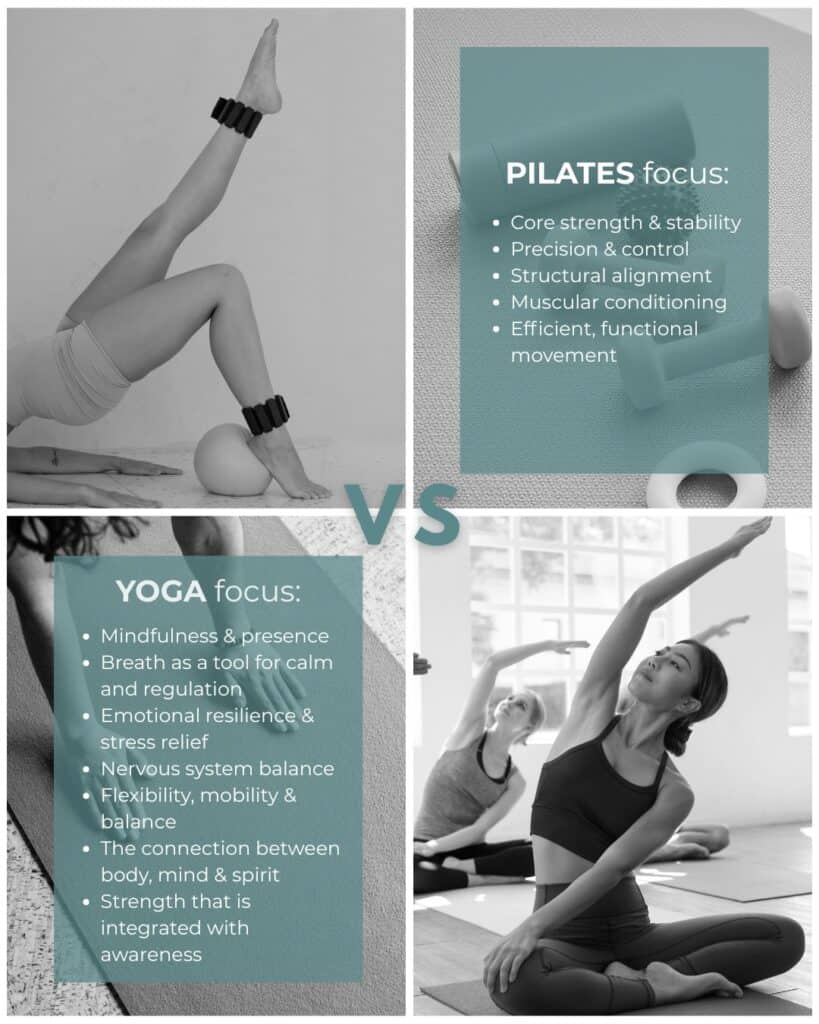
Yoga emphasizes:
- Mindfulness and presence
- Breath as a tool for calm and regulation
- Emotional resilience and stress relief
- Nervous system balance
- Flexibility, mobility, and balance
- The connection between body, mind, and spirit
- Strength that is integrated with awareness
Pilates emphasizes:
- Core strength and stability
- Precision and control
- Structural alignment
- Muscular conditioning
- Efficient, functional movement
In simple terms, Pilates refines how the body moves. Yoga explores how we experience that movement while also strengthening the body through breath-led, mindful effort.
The Nervous System Connection
One of the main differences between the two practices is how they affect the nervous system.
Many styles of yoga incorporate slower movement, breath awareness, and mindful pacing to help shift the body out of stress mode and into a more grounded, restorative state. That’s one reason so many people leave class feeling calmer, more centered, and more connected to themselves.
Pilates tends to be more active and effort-based, which can feel energizing, focused, and empowering. It asks for concentration, control, and precision.
Both are valuable as they meet different needs.
Why Both Belong in a Holistic Practice
Yoga and Pilates work beautifully together. Pilates builds the physical structure that supports movement, while yoga supports the inner experience – how we breathe, respond, and relate to ourselves along the way. Yoga also strengthens the body through balance, stability, endurance, and intentional movement, making it a powerful complement to Pilates’ precision and control.
A More Complete Kind of Strength
At Mountain Yoga Sandy, we believe wellness is about more than just our physical body. It’s about how we move, breathe, handle stress, and how connected we feel to ourselves.
Yoga and Pilates each offer something meaningful. One builds strength through breath, presence, and connection. The other builds strength through precision, control, and alignment.
And that balance can help create a more grounded, resilient, and sustainable path to whole-body wellness.